Progressives did well yesterday
Won big in Minnesota. Lost by a hair in Wisconsin.

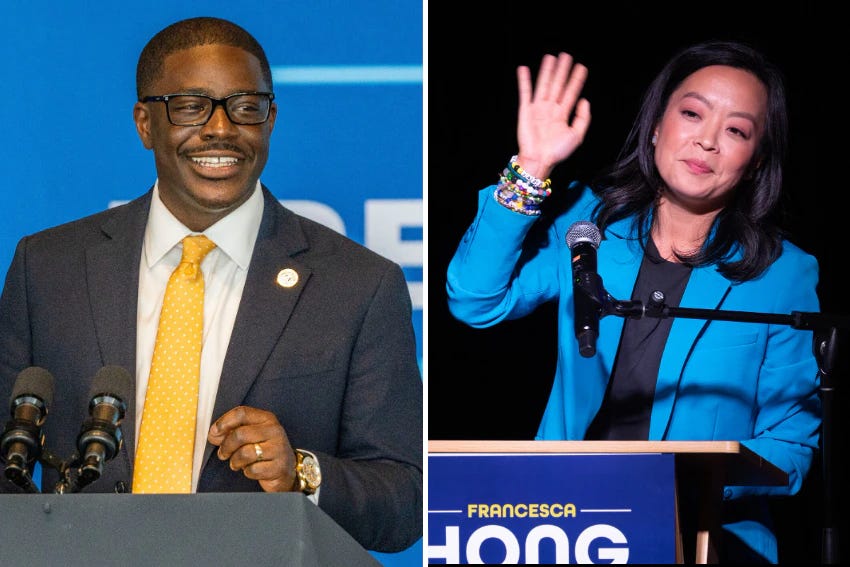
Progressives won big in Minnesota but lost narrowly in Wisconsin, producing a mixed but still encouraging night for the left. Minnesota Democrats delivered a top‑of‑ticket win for the progressive wing in the Senate primary while centrist Democrats squeaked out a win over a socialist in the gubernatorial primary.
Peggy Flanagan won the U.S. Senate primary with 59% of the vote over centrist Rep. Angie Craig. Flanagan’s win was widely interpreted as a progressive victory, reinforcing the momentum generated by Abdul El‑Sayed’s Michigan win the week prior. These results show Minnesota’s Democratic electorate leaning left statewide, especially in highly educated areas where progressives performed best.
The lingering impacts of the deadly ICE invasion in Minnesota had dogged Craig, who as a congresswoman voted for the Laken Riley Act, a federal law that requires immigration detention for undocumented immigrants accused of local crimes. In March, Craig said she regretted her vote on the act, but it has followed her throughout her Senate campaign.
* * *
Wisconsin moderate David Crowley beat Democratic-socialist Francesca Hong by less than half a percentage point in the governor’s race. The core differences between Hong and Crowley weren’t about which issues they cared about — both ran on affordability, childcare, healthcare, and schools. Hong ran as a socialist, proposing structurally transformative measures. Crowley ran as a center‑left pragmatist emphasizing deliverability and electability.
Hong didn’t lose because her message collapsed. She lost because — well, who knows? The vote was so close. Hong strongly opposed ICE, supported abolition of the agency, and proposed laws making it a state felony for federal agents to be within 250 feet of polling places. She also made some inopportune comments about abolishing Thanksgiving and the police that she was forced to retract.
Crowley opposed Hong’s abolitionist politics, including abolishing ICE or criminalizing ICE proximity. Given that the distance between the two candidates was so narrow, I wouldn’t call this a defeat for the socialists or progressives.
This from the Washington Post:
Alex Brower, a Milwaukee alderman and democratic socialist, tied such concerns to a last-minute scramble from party leaders as they sought a more moderate alternative to Hong and elevated Crowley, who had previously dropped out of the crowded primary.
“They broke the glass, and they pulled the emergency lever here in Wisconsin,” said Brower, who canvassed for Hong. He compared the effort by centrist Democrats to their push against Bernie Sanders, the democratic socialist senator from Vermont, who won all but one county in Wisconsin in the 2016 Democratic presidential primary but lost the state in the 2020 nominating contest.
Hong spent more time campaigning in rural Wisconsin than any other candidate, and it appeared to pay off, given how well she was doing there. Democratic socialists and other progressives have won a string of races on the strength of their ground games and populist left-wing proposals that are resonating with many voters. It just wasn’t enough to push Hong over the top.
It probably did not help Hong that prominent DSA voices, such as Senator Bernie Sanders of Vermont and Representative Alexandria Ocasio-Cortez of New York, pointedly did not endorse her after publicly backing El-Sayed in Michigan.
* * *
Side note: Neither AIPAC money nor big corporate donations seemed to be much of a factor in yesterday’s outcomes. Crowley’s money came from institutional sources, the DNC, and labor unions. Hong’s fundraising was movement‑left, grassroots, and low‑dollar, built around progressive donors and organizations that support structural reform.