Why I read obits.
This one tells a tale of guns, drugs, and CIA intrigues in Latin America.

For some reason, I find myself checking the obits page daily. I’m not sure why. Maybe to assure myself that mine isn’t there yet. But many of them grab my interest because of the stories they tell about the deceased’s life and times. I’m just a sucker for a good tale of political intrigue where I can find one.
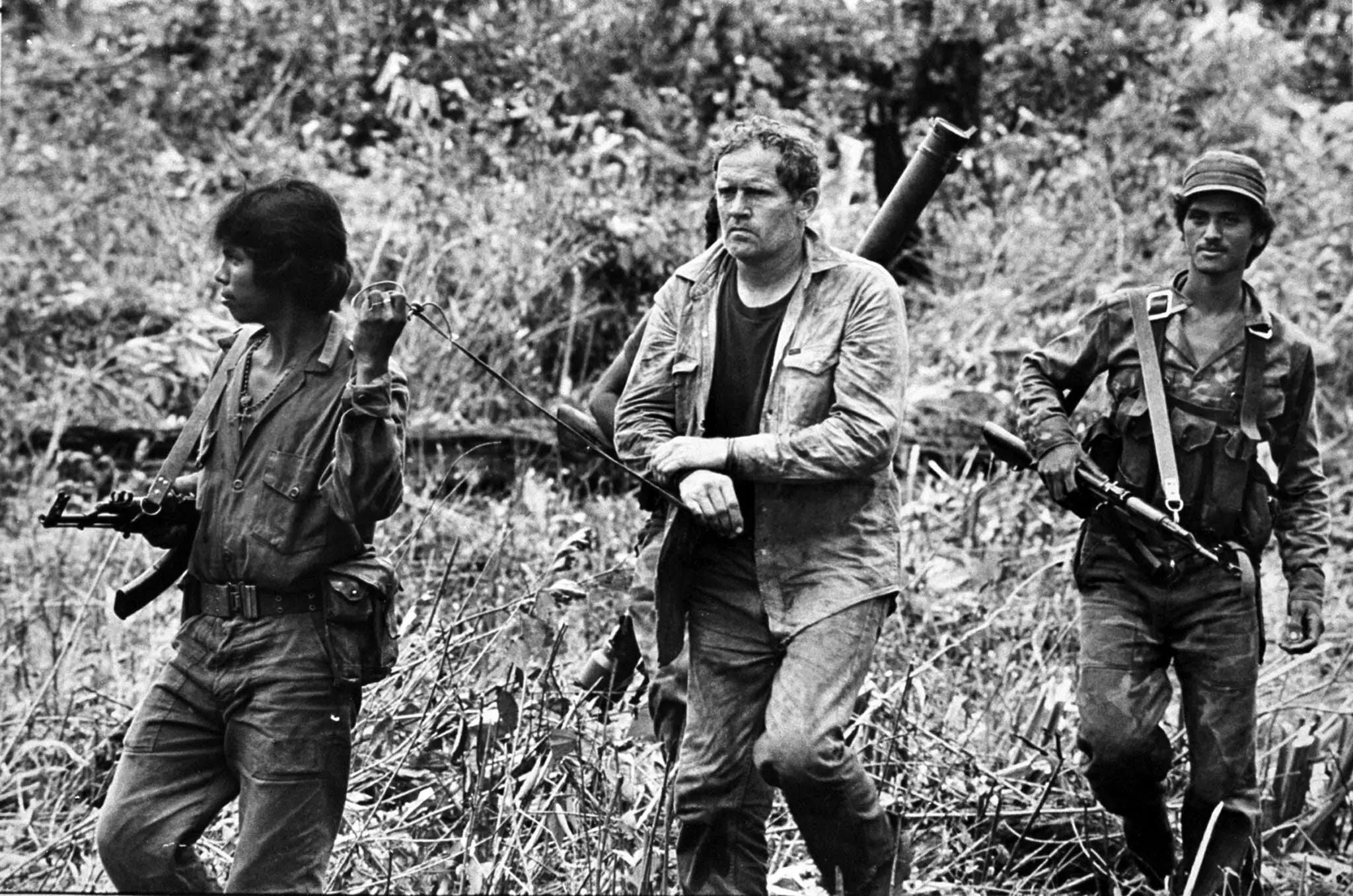
It’s about Eugene Hasenfus, who died on Wednesday at his home in Menominee, Mich. He was 84.
When Hasenfus was a 45-year-old former Marine and laid-off construction worker, he was thrust into the national spotlight in 1986 when, on a covert mission sponsored by the CIA, his gunrunning cargo plane was shot down over Nicaragua, setting off what would become known as the Iran-Contra affair.
Hasenfus emerged out of obscurity on Oct. 5, 1986, when a missile fired by troops fighting for Nicaragua’s leftist government downed his plane while it was on a run to drop arms to right-wing rebel forces, known as contras, who were seeking to overthrow the Sandinista government. The pilot, co-pilot, and radio operator of the plane, a twin-engine vestige of the 1950s, died in its fiery crash in a patch of jungle in southern Nicaragua. Hasenfus, who had been responsible for packing and dropping the arms, was the lone survivor, captured and taken prisoner by government troops.
President Reagan’s administration initially denied any American involvement in the flight. Those denials began unraveling when it was reported that the cargo plane belonged to Southern Air Transport, a charter carrier based in Miami that was formerly owned by the C.I.A.
It turned out that U.S. officials knew that Contras were smuggling cocaine to finance their war. U.S. funds for “humanitarian aid” to Contras ended up with drug traffickers. Gary Webb’s Dark Alliance series (1996) revealed that Contra-linked traffickers helped fuel the crack epidemic in Los Angeles. His reporting suggested CIA complicity, sparking public outrage.
Hasenfus was convicted and sentenced to 30 years in prison, then freed in December 1986, in what Daniel Ortega, the Sandinista leader who is now the country’s president, called an act of goodwill toward the United States.
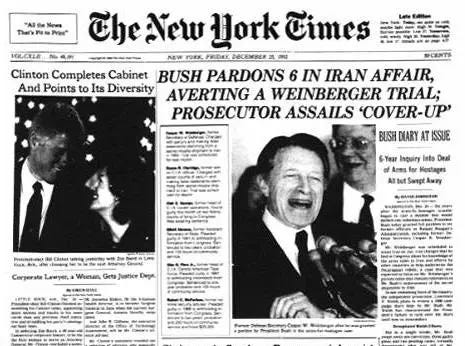
Fourteen figures from the Reagan administration, the C.I.A., and the private network funding the contras faced criminal charges arising from the scandal. President Bush issued six pardons to Iran-Contra defendants in December 1992 after losing to Bill Clinton in his bid for re-election.
Life did not go well for Hasenfus after the scandal. He and his wife divorced. His house burned down, and in 2003, he pleaded guilty to a charge of lewd, lascivious behavior after he exposed himself in the parking lot of a grocery store. His probation was revoked in 2005, and he spent more time in prison.
There’s so much more to this story, but it’s too long a tale for these pages. However, it’s all documented here in the National Security Archive at George Washington University.
* * *
The main reason I shared Hasenfus’ obit was to show how the echoes of U.S./CIA intrigues in Latin America 40 years ago still reverberate today. The names of the players, Reagan, Bush, North, and Pondexter, have changed to Trump, Hegseth, Bradley, and Rubio. But guns, drugs, and regime change are still the staples of U.S. foreign policy in Latin America.
Today, the echoes lie in how regime-change efforts continue under new guises, with the same hallmarks: secrecy, deniability, and narrative control.
The criminal use of the presidential pardon. Bush pardoned the Iran-Contra gun/drug runners in 1982, while Trump just pardoned former Honduran President Juan Orlando Hernández, who had been convicted of trafficking more than 400 tons of cocaine into the United States.
Hasenfus’ case showed how the CIA used contractors and “deniable assets” to run covert wars. Similar methods appear in today’s reports of shadowy logistics, mercenary involvement, and clandestine funding streams.
Just as Reagan officials denied Hasenfus’ CIA ties, Trump officials are engaging in spin control and plausible deniability tactics in the attacks on the boats of alleged drug traffickers.
Covert U.S. operations destabilized Nicaragua in the 1980s; today, Haiti, Venezuela, and Cuba are threatened by Trump’s destabilization tactics.
To quote Will Shakespeare: The past is prologue.

Here is another related story about how clandestine CIA operations work. In this case, I report an operation done with enough subterfuge to fool the people directly involved. In the early 1960s, the Smithsonian funded seabird research in the Pacific. Not a lot was known about their natural history, and several valuable papers on their breeding, diet, and migrations came from these expeditions. But it turns out that the money actually came from the CIA; the Smithsonian was laundering it. Why was the CIA interested is seabird biology? It was all about seabird migrations. They were looking for a bird whose migratory route would bring it over North Korea or (then called "Red") China, or perhaps parts of Indochina, so the birds could be used as vectors to carry biological warfare agents. Many years ago, I talked to a couple of ex-sailors who were on a ship that was part of this Smithsonian project and they told me that all the sailors knew what was going on; only the scientists were in the dark about the real reason for their research. Actually, the story had broken years before that in the scientific press to the horror of many in the field. Now, decades later I have found more evidence of this. I found a paper in the literature from 1946 about the natural history and migration of four species of oceanic terns. The paper was written in Scandinavia but the search engine found an English translation...in the U.S. Army Biological Laboratories of Fort Detrick from 1963. Fort Detrick was the center of U.S. biological weapons development for decades.
Mike I find it very curious that Trump and Mr. War Dept. are so interested in going after "supposedly" cocaine runners and yet talks about how much more deadly Fentanyl is---and we all know that the major supplier of this drugs comes from the so call "labs" from China and distributed through Mexico into the US. So, I wonder why Mr. Sleepy head has not gone after the ships which are coming in from the Far East??